Featured

|The Hindu Summary along with Free Notes in PDF|

The Hindu summary of 6th January 2020 is given below Read it carefully you will get an attached pdf of notes along with it for Free :-

So the First News which is important for GS Paper IInd is :-
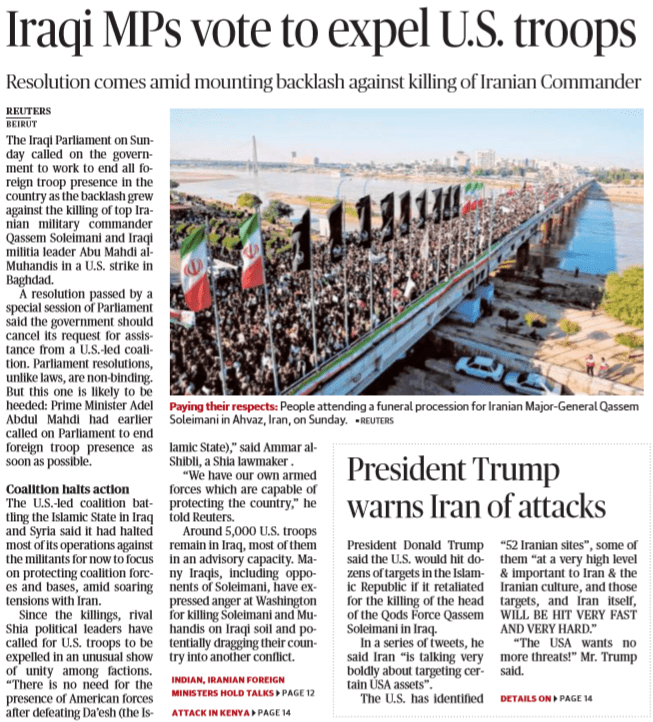
The Hindu 6th january 2020

Basically we have to understand that why “Iraqi MPs vote to expel U.S. troops” so lets Go Back in 2001 When Al-qauida (organisation found by osama bin laden) Attacked USA in which more than 3000 civillians lost their lifes mostly known as The 9/11 Attack. so the US government ( G W Bush government) ask Afghanistan Taliban To hand-over Osama-bin-laden to US , Taliban Refused to hand-over Osama-bin-laden to US so Ultimately in October 2001 US attacked Afghanistan during this Attack G W Bush Also talked about “Axis of Evil ” it includes those countries those countries who are supporting terrorism , in possession of “WEAPONS OF MASS DESTRUCTION” and three countries made up of this axis:-

1) Iran 2) Iraq 3) North Korea

Iraq was alleged to be in possession of “WEAPONS OF MASS DESTRUCTION” so US and its Allies decided in 2003 that this is the time to launch a war against Iraq because Iraq was alleged to be in possession of “WEAPONS OF MASS DESTRUCTION” and Iraq is a threat to US and its Allies and Iraq was that time rulled by A Dictator “Saddam Hussein” Even before the war Saddam Hussein Allowed international Agency such as IAEA To Visit Iraq and check weather Iraq is in possession of “WEAPONS OF MASS DESTRUCTION” or not , but US and its Allies launched a war against Iraq Saddam Hussein Government was d-throned and saddam Hussein was caught alive and Hanged after the war was over no evidence of WMD was found in Iraq but this war transfer Iraq from a stable to Unstable country.

In 2009 the US President Barack Obama pulling the US troops from Iraq but then “Iraq gave birth to ISIS ” and to fight ISIS US troops decided to stay back in Iraq almost 5000 are thier in Iraq to support Iraq police to fight Against ISIS and because of the killing of “Qassem-saleimani” top millitary comandant of Iraq now As ISIS was defeated “Iraqi MPs vote to expel U.S. troops”

Another New from Page no:- 1 The Hindu 6th january 2020 Important for Prelims:-

As we know About Gaganyaan ( India’s first man mission to mars ) 4 Indian Airfrorce Pilots have been selected and sent to Russia for training but the question is why not in India so the Reason is We don’t have all the facilities which are required for this training but ISRO has proposed a Rs 2700 crore master plan to create top infrastructure so that in future we don’t require to send our people to outside for training and the place will be known as ” Human Space flight Centre (HSFC) ” located in karnatka.

Another New from Page no:- 8 The Hindu 6th january 2020 Important for (GS IInd Exam):-
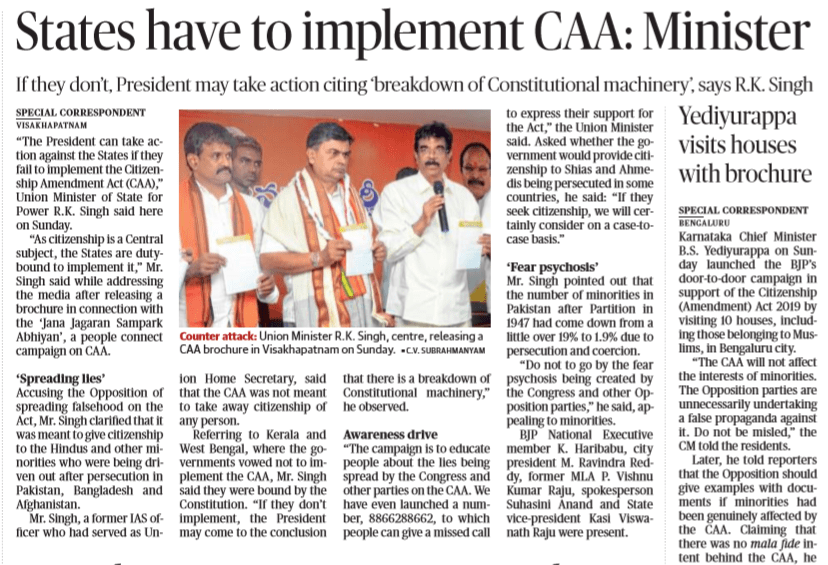
CAA has now become the Law of Land as it was passed by the parliament NPR ( National Population Register) has also been approved by union cabinet thier are several states which are catagorically stated that they are not going to impliment CAA like west bengal and kerala.

In above editorial the minster said that if any state does not impliment CAA than President rule under Article 356 will be imposed on them so the question is …. Is it Possible?

Lets take a look…….

There are two obligation on the part of the state:-

  1. Whenever a law is passed by the parliament it is the responsibility of the state to comply with those laws.
  2. It is the obligation on the part of the state government that whenever the central government is doing something exercising it executive functionality and if the state government is interfaring with the legitimate function of the centeral government than in both of these cases direction will be given by central government to state government.

And if then also the state government doesn’t follow the directions by central government than the President rule under Article 356 can be implimented.

Another New from Page no:- 9 The Hindu 6th january 2020 Important for (GS IIIrd Exam):-
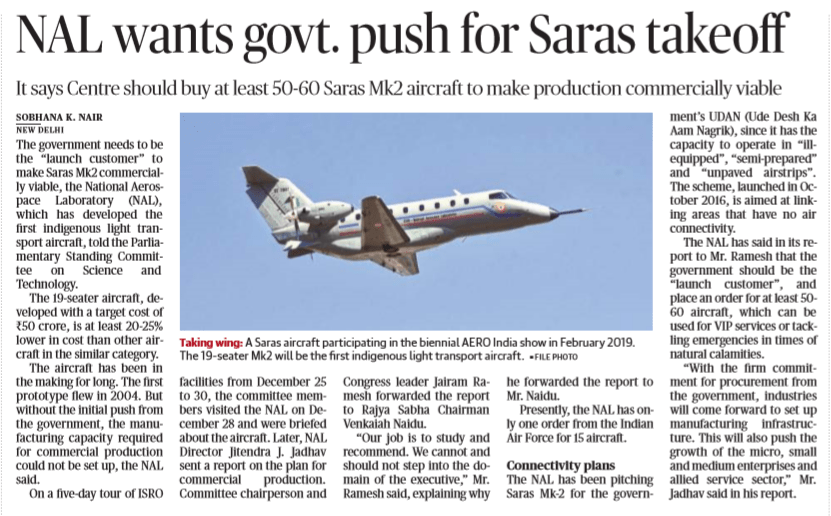
Saras is India’s first indigenous light transport aircraft it is designed by a NAL national aerospace laboratories this NAL was established by the council for scientific and industrial research in the year 1959 can be important statement for your prelims exam initially it was headquartered in Delhi but in 1960 the headquarter was shifted to Bengaluru , NAL works closely with Hindustan aeronautics limited defence research and development organisation and Indian space organisation what is the prime responsibility of NAL the prime responsibility is developing civilian aircraft in India and NAL has developed in design SARAS which is India’s first light transport aircraft the first prototype of saras flu in the year 2004 later it was reported by newspapers that the project has been cancelled but in 2017 the project was revived now any NAL has told the parliamentary committee on science and technology that in order to give push to saras government should be the launch customer of these aircrafts that means the central government should buy at least 50 to 60 saras aircraft so that this project can become commercially viable and these aircraft can be used under udan scheme which is regional connectivity scheme of the Government of India please aircraft can also be used for VIP services as well that’s what you need to understand from this article.

Now we Look at the Editorial Column of The Hindu:-
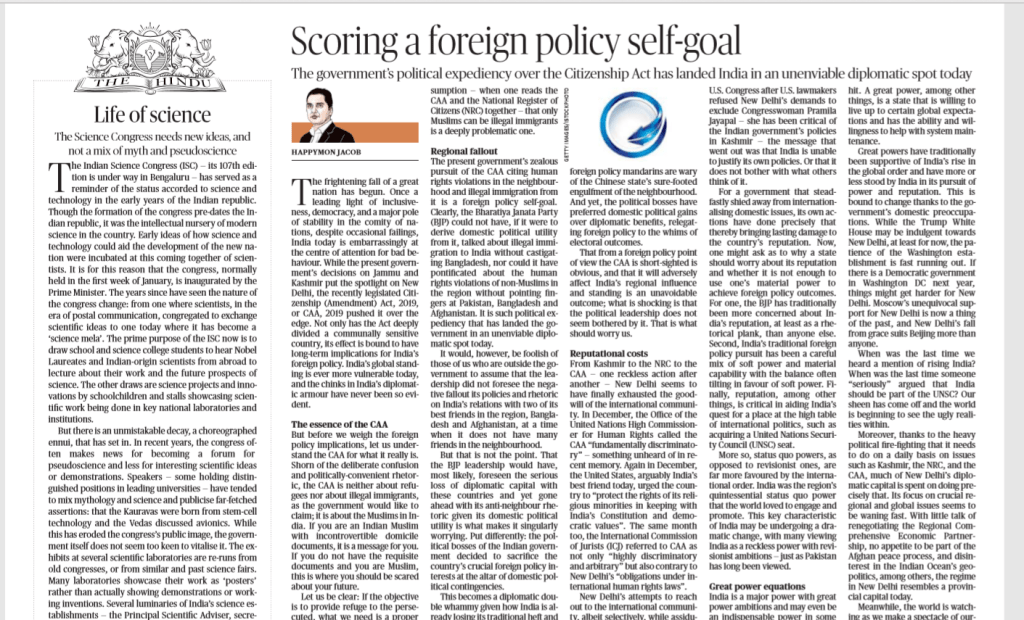
First scoring a foreign policy self goal written by professor Jacob who teaches at JNU Delhi this is similar to the column written by Suhasini Haidar on January to 2020 in which the author says that the actions of the government on article 370 as well as on citizenship amendment act look like foreign policy self goals Mr Jacob argues when was the last time we had the mention of rising India when was the last time a foreign government tells back India’s permanent membership of United nation security council because now Indian diplomats are busy trying to explain to the world leaders trying to explain to the international powers why did we revoke the special status of Jammu and Kashmir why are the bringing about citizenship amendment at why are we trying to run out National register of citizens in this country Mr Jacob argues that if the objective of the government is that refugees from three countries who have been persecuted because of their religion if the objective of the government is to provide citizenship to the refugees then there was no need for citizenship amendment act in state the need was to have a refugee law in this country this refugee law should happen non-discriminatory as well because of all these decisions the author argues that India’s reputation has taken a hit we will lose our friends like Bangladesh and Afghanistan and that is why all are diplomats are busy in browsing the fires lit by these decisions of a government and that is why we are not in a position to decide whether we should join our CET or not what is going to be India’s role in Afghan peace process and weather India should join Japan and Australia in launching of front against China in Indian ocean region true that India can insert it’s diplomatic power in the neighbourhood that is what does newspaper column is all about.

Second Indian science Congress is India’s premier scientific organisation its headquarter is in Kolkata it was set up in the year 1914 the meetings of Indian science Congress are held annually in the first week of January can be an important statement for your prelims examination more than 30000 scientists who are the members of Indian science Congress and what is the objective of Indian science Congress to promote to advance because of science in India it’s not forget part 4A of the constitution talks about fundamental duties and one such fundamental duty is to promote scientific temper Indian science Congress has been at the centre of controversy for example last year a scientist say that covers work on using stem cell technology Andhra Pradesh University vice chancellor last year said that Ravan has 24 types of aircraft a professor from Tamil naidu say I hold degree in renewable energy when there is no such department as renewable energy in 2016 and Nobel laureate of Indian origin Venkatraman Ramakrishnan said I am not going to participate in Indian science Congress meetings since it is a circus there are people who say Indian science Congress is nothing but comedy for example of minister last year said that Stephen Hawking has accepted that there is that are mentioned in Vedas are superior than Einstein’s theory of relativity one member at the meeting of Indian science Congress last year said that Darwin’s theory of evolution is scientifically wrong express last year road that in India today stand up comedians say anything which is critical of a government for the members of the ruling party then they are arrested so Indian express road which means in India we take comedy too seriously and science today has now become comedy editorial also talks about it says that the science Congress needs new ideas and not the mix of myth and serial science what you need to understand from this editorial.
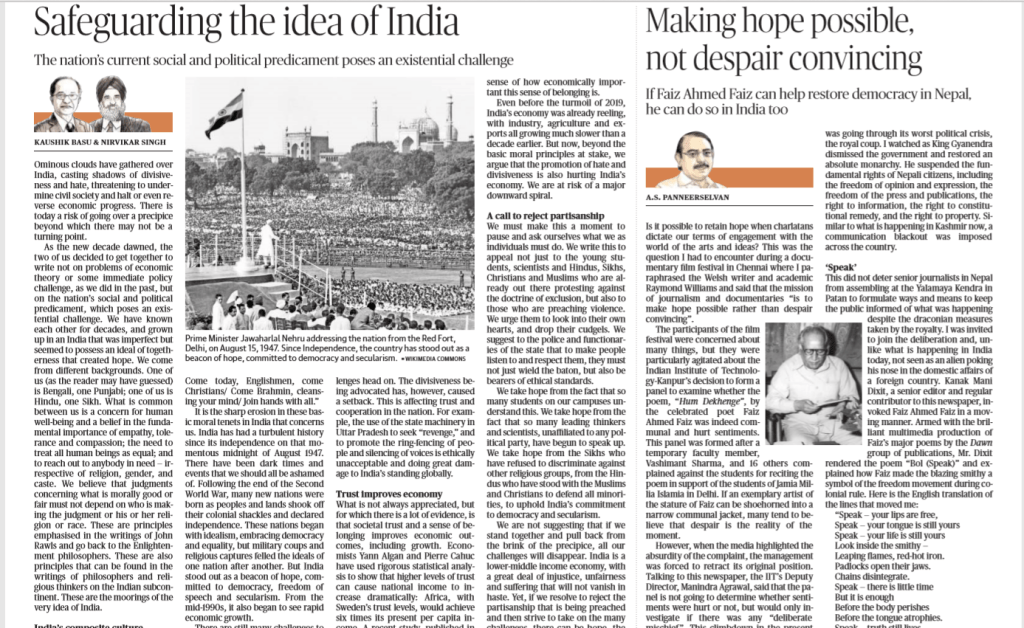
Those who will be appearing for civil services examination interview this can be a potential question asked by the panel in students for protesting against citizenship amendment act national register of citizens the assault on students at Jamia University the students took out protest matches and some of them also read the poem of Faiz Ahmed Faiz hum dekhenge when the students at IIT Kanpur read this poem of faculty at IIT Kanpur lodge the complaint and said this poem is anti Hindu it is also anti National committee was setup to prove whether this poem is Anti-national or anti Hindu although IIT Kanpur lecture on clarified that our committee is not going to investigate whether this poem is anti Hindu but it has generated a lot of controversy and let’s understand this newspaper column in slide detail Faiz Ahmed Faiz is one of the most renowned dhup rates is in the category of Mir taqi Mir Iqbal and Ghalib but faiz is also different from them is not like Ghalib been made because both of them were involved in romantic poetry Iqbal was more into religion his poetry represents more of Islamic philosophy but face was a revolutionary poet he wrote his famous poem mujhse pehli si Mohabbat mere Mehboob na maang Love you my target is a romantic poem but it is not in fact he wrote this poem when has read the communist manifesto written by Karl Marx and his friend Frederick Angels face was also against the division of the country on religious lines when general zia ul haq imposed martial law in Pakistan suspended the constitution of Pakistan has was highly critical of zia ul haq and here to spend some time in jail as well in 1979 Faiz Ahmed Faiz rote hum dekhenge lajim hai ki ham bhi dekhenge we shall see we are testing to see what was he talking about he was talking about social justice critics argue that in his poem hum dekhenge his talking about anal haq a nice talking about the role of the man of God that is why it is Islamic fundamentalism it is empty Hindu and that is why this form should be banned but the column is argues that when he writes on the lock and the rule of the man of God it is against zia ul haq because you want people to revolt against the Islamic fundamentalism of zia ul haq and ensure social justice in the society so this poem cannot be entirely Hindu cannot be Islamic fundamentalism care panneer selvam who is the readers editor of the Hindu he talks about his personal experiences in Nepal when in Nepal king and his mistake payment and imports absolute monarchy it was then that civil society activist journalist and writers the protested against the king by singing the terms of Faiz Ahmed Faiz and they were singing Faiz Ahmed Faiz most render to ham bol bol ke lab azaad Hain tere bol kaise hua ab tak Teri hai speak your lips are free speak your tongue is still yours and later on democracy was restored in Nepal so the writer says if else can help restored democracy in Nepal I can do so in India to you may agree or disagree with the writings of both of Columbus but that is what you need to understand from.

Hope you all Found This Blog helpful And please subscribe to our blog for daily updates…..

Join 43 other subscribers

Rating: 1 out of 5.
  1. Sanyam Kalra's avatar

Is UPSC planning to remove optional from the cse 2020?

Is UPSC planning to remove optional from the cse 2020?

Sanyam kalraMarch 15, 2020

Is UPSC planning to remove optional from the cse 2020?

No in 2020 upsc is not removing the optional and everything remains same as earlier It can’t be determined exactly when the optional subjects would be done away with by the UPSC. Whenever it is, uniformity across subjects will ensue and all attempting the Main Exam would be judged on more common and universalistic parameters.

Is UPSC planning to remove optional from the cse 2020?

But despite this what we cannot wish away is the fact that we will in any case need to be strong with the domain knowledge of esp those optional papers which lend themselves towards society and humanity and therefore so important to the scheme of CSE.As such, General Studies Papers of the post 2013 era esp might have become more generic but the questions demand a broad based approach and a foundational vision which duly is the outcome of the combination of strands of knowledge derived from disciplines ranging from Sociology, Public Administration, Management, Philosophy, Human Geography, Psychology and so on.In conclusion, even in the near future when optionals will have been phased out, the UPSC Syllabus of the aforementioned optionals will NECESSARILY be required to be studied and those topics having contemporary relevance mastered with finesse

Is UPSC planning to remove optional from the cse 2020?

It is not removed according to Official Notification Of UPSC Civil Service EXAMINATION 2020.

Union Budget 2020: Detailed Analysis for Government Exams UPSC IAS, SSC, IBPS

Union Budget 2020: Detailed Analysis for Government Exams UPSC IAS, SSC, IBPS

Union Budget 2020-21: Check detailed analysis of the Union Budget announcements made by Minister Nirmala Sitharaman. Know the theme of Union Budget, major budget allocations and new schemes along with the changes in Tax Structure.

Union Budget 2020 is presented in the Lok Sabha by Finance Minister Nirmala Sitharaman. The Budget 2020 is focussed on 3 major themes – Aspirational India; Economic Development for all & A Caring Society. The Budget allocates funds and proposes new schemes for every sector under these three themes. Get here the detailed analysis and highlights of the Union Budget 2020 and know Important Policy Decisions taken by the Finance Ministry along with New Schemes and changes in Tax Slabs. Watch what Budget holds for the year 2020 in terms of allocated finances of Central as well as State Governments, estimated expenditure to be incurred in 2020-21 and revenues expected to be earned through such expenditure.

The year 2019 has been a bit challenging in terms of economic growth and development globally as well as nationwide. A steep decline in the GDP growth rate was witnessed during the July-September quarter of 2019 in India; GDP stood at its lowest at 4.5 percent. The Union Budget 2020 is focused on reviving the Indian Economy in this fiscal through changes in Income Tax Slabs, taxation reforms, policy changes for Real Estate Sector, the resurgence of Automobile Sector, encourage privatization in CPSEs, boost for MSMEs, Bank reforms and so much more.

Here is the complete analysis and major highlights of the Budget 2020:

Theme: Aspirational India; Economic Development for all & A Caring Society

Languages used in Union Budget 2020: Hindi, English, Kashmiri, French

Theme 1: ASPIRATIONAL INDIA

Image result for agriculture budget"

Agriculture Sector

• Budget is aimed at doubling farmer income by 2022 by: State governments to implement national laws such as Contract Farming, 2018, APMC, 2017 and Model Agriculture Land Leasing Act, 2016; Comprehensive measures to be undertaken for 100 water-stressed districts; Provide stand-alone solar pumps to around 20 lakh farmers; Over 15 lakh farmers with barren lands will be allowed to solarise their farms and Balanced use of fertilisers to transform current incentive regime
• “Aathichudi by Auvaiyar. Bhoomi Thiruthi Unn”: It means to take care of your own land first
• Village Storage Scheme run by self-help groups: Women self-help groups can now get help from NABARD or Mudra.
• The horticulture sector has exceeded the production of foodgrains by around 311 million metric tons of production. The government will help those states that work for ‘one product, one district’.
• Integrated Farming Systems to be developed in rain-fed areas
• Negotiable Warehousing Receipts Financing has crossed Rs 6,000 crore.
• Budget fixes the target of Agricultural Credit at Rs 15 lakh crore. 
• All beneficiaries of PM Kisan scheme will now be covered under the Kisan Credit Card (KCC) scheme.
• MNREGA will be merged for creating fodder farms.
• Fish production to be raised to 200 lakh tones by 2022-23
• Indian Railways to set up “Kisan Rail” so that farm goods can be quickly transported. It will also be used for cold storage of goods through PPP model. 
• Ministry of Civil Aviation will launch Krishi UDAN on international and national routes.

Wellness, Water and Sanitation

• Budget allocates Rs 12,300 crore for Swachch Bharat Mission 
• Budget talks about the “Fit India Movement” in the context of India’s fight against the NCDs – non-communicable diseases.
• Budget seeks to set up hospitals in Indian Tier-II and Tier-III cities under the PPP model.
• Jan Aushadhi Kendra will be expanded.
• Budget allocates Rs 69,000 crore for the Health sector

Education Sector

Image result for education budget"

• Union Budget 2020 proposes foreign direct investment, FDI and External Commercial Borrowings (ECB) in education.
• As per the budget, 150 higher education institutions will start apprenticeships in 2020-21.
• Urban Local Bodies have been asked to provide internship opportunities for freshers and engineers for a period of one year.
• A degree level online education programme will be launched to provide quality education to deprived sections students.
• INDSAT exam will be conducted in Asian and African countries under the Study in India programme. 
• Budget proposes to set up “National Police University” and “National Forensic Science University”.
• Budget proposes to attach a Medical College to every existing district hospitals under the PPP model.
• The Budget allocates Rs 99,300 crore for the Education sector and Rs 3000 crore for Skill development.

Theme2: ECONOMIC DEVELOPMENT

Image result for economic development"

• Union Budget 2020 proposes to set up an “Investment Clearance Cell” to offer services such as to be set free investment advisory, land banks and others. An online portal will be launched in this regard.
• A new scheme proposed in electronics manufacturing to spur investments. 
• National Technical Textiles Mission proposed.
• All ministries will issue quality standards. A new scheme,
• New scheme “NIRVIK” announced for fewer duties and taxes on exported products. The scheme will be launched in 2020-21.
• Budget proposes to make each district an export hub. 
• Budget allocates Rs 27,300 crore for development of industry and commerce in 2020-21
• National Infrastructure Pipeline to offer employment opportunity
• Government to form a National Logistics Policy soon
• It proposes to build the Chennai-Bengaluru Expressway

Indian Railways

Image result for railway budget"

• Electrification of around 27000 km of railway lines achieved within 100 days of Modi Government formation in 2019. 
• A large solar power capacity proposed for the Indian Railways. It will be built along the rail track on the Railways owned lands.
• Bengaluru Suburban Rail Project proposed; budget allocates Rs 18,600 crore for this project
• By 2024, the Government would monetize 12 lots of national highways
• With the help of UDAN scheme, 100 airports will be built by 2024
• The fleet of Aircraft will be increased to 1200 planes by 2024
• Rs 1.7 lakh crore allocated for transport infrastructure

Energy Sector

Image result for energy sector in india"

• Prepaid Smart Meters: States will have to replace existing energy meters with the prepaid smart meters.
• Budget allocates Rs 22,000 crore for the Power and Renewable Energy Sector.
• The national gas grid will be expanded from 16200 km to 27000 km.
• A new policy will be launched for the construction of data centre parks by the private sector. 
• Bharat Net to link 1 lakh gram panchayats through Fibre to Home connections
• Budget allocates Rs 6000 crore for the Bharat Net programme 
• It provides Rs.8,000 crore in the next 5 years for “National Mission on Quantum Technology and Applications”.

Theme 3: A CARING SOCIETY

• ‘Beti Bachao, Beti Padhao’: Enrollment of girls in schools is higher than the boys.
• Rs 35,600 crore will be provided for nutrition-related programmes
• Task Force will be constituted to look into the issue of girls of low age entering motherhood
• It allocates Rs 85,000 crore for development of SCs and OBCs
• It allocates Rs 53,700 crore for STs development 
• It allocates Rs 9,000 crore for Senior citizens and persons with disabilities

Art & Culture

Image result for art and culture in india"

• The government will constitute “Indian Institute of Heritage and Conservation” as a deemed university
• 5 archaeological sites to be developed as top-notch sites; these sites are
Rakhigarhi, Haryana
Hastinapur, Uttar Pradesh
Sivasagar, Assam
Dholavira, Gujarat
Adichanallur, Tamil Nadu
• The government will build a Tribal Museum in Ranchi.
• The budget allocates Rs 3150 crore for the Ministry of Culture

Tourism Sector

The Tourism Sector will grow at 7.8% to Rs 1.88 lakh crore.

Climate

• The Coalition for Disaster Resilient Infrastructure will be implemented from January 2021.
• It allocates Rs 4,400 crore to promote clean air in cities with a population of over 1 million people.

Banking Sector

Image result for BANKING DECTOR in india"

• To avoid the case of citizen harassment, a taxpayer charter will be enshrined in the statutes.
• For recruitment in non-gazetted posts in banks, National Recruitment Agency will be constituted for both government and public sector banks.
• It proposes the creation of the New National Policy on Official Statistics
• Deposit insurance cover has increased tremendously from Rs 1 lakh to Rs 5 lakh.
• Disinvestment in Banks: Government’s share in IDBI Bank will be sold to the private sector.

MSME & Corporate Sector

• The budget proposes a new scheme for MSMEs in the context of subordinate debt. 
• The debt recast window of MSME is extended by one year to March 31, 2021.
• Certain categories of government securities will now be opened for Non-Resident Investors. 
• The FPI Limit in Corporate bond has increased to 15%.

Strategic Disinvestment & Privatization

Finance Minister Sitharaman proposes to sell the Government’s stake in the Life Insurance Corporation of India (LIC). For this purpose, the LIC IPO will be launched.  

Note: Budget calls for the overhaul of certain centrally sponsored schemes which includes central government debt which is not a part of market borrowings, however, is used for funding expenditure.

Union Budget 2020

The Union Budget is the annual budget of the Indian Republic. It is presented every year in the month of February generally by the Union Finance Minister. In this page, you can read all about what a budget is, and what to expect in the Union Budget 2020-21. This is an important topic for the UPSC exam.

Union Budget

The Union Budget is also known as the Annual Financial Statement. Article 112 of the Constitution of India lays down that it is a statement of the estimated expenditure and receipts of the Government for a particular year. 

  • The Budget keeps the account of the finances of the government for the fiscal year (from 1st April to 31st March).
  • The Budget is presented on 1st February (until 2016, it was presented on the last working day of February) so that it can materialise before the commencement of the new financial year which starts on 1st April. 
  • In 2017, a 92-year-old tradition was broken when the railway budget was merged with the Union Budget and presented together.
  • The Budget has to be passed by the Lok Sabha before it can come into effect.
  • The Union Budget is divided into Revenue Budget and Capital Budget. For more on these terms, check Union Budget – Important Economic Terms.
  • In the Union Budget, the disbursements and receipts of the government comprise the various types of government funds in India namely, the Consolidated Fund of India, the Contingency Fund and the Public Account. 
  • The Economic Survey of India is released ahead of the presentation of the Budget. This document is prepared under the guidance of the Chief Economic Advisor and is presented for discussion in both Houses during the Budget session.

Union Budget 2020-21: What to Expect?

The Union Budget 2020 will be presented by the current Finance Minister Ms Nirmala Sitharaman on 1st February 2020. The current Budget will be presented during a time of an economic slowdown with the projected GDP growth for 2019-20 at an eleven-year low (5%).

Some expectations, as reported by leading newspapers are briefly talked about below.

Personal income tax cut

This has been a demand especially among the salaried class in the country. Many feel that if people save on taxes, they can spend more and hence, cause a rise in the demand (which is said to be one of the causes of the current slowdown). However, many experts also feel that a cut in personal tax rates might not actually lead to a demand rise.

There might be an increase in the income tax exemption limit, point out newspapers.

Sector-specific measures

Many economists feel that the government should announce sector-specific measures that are necessary to revive the overall demand.

Controlled consumer inflation

Another incentive for the common man would be if the prices of fruits and vegetables would stay within limits. The government should ensure that inflation does not rise beyond a point. Consumer Price Inflation (CPI) of 7.35% (December 2019) is very high.

Higher tax benefits on housing schemes

There is an expectation that the Finance Minister will raise the tax exemption limit for affordable houses. The previous budget had offered a tax exemption of Rs.1.5 lakh for houses bought under Rs.45 lakh. This is expected to rise to Rs.75 lakh since in metros such as Mumbai and Delhi, houses are more expensive.

Low GST on consumer durables and FMCG products

Newspapers report that the GST rates on some of these items would be brought down to boost consumption.

LTCG and DDT

The Budget might also offer relief on long term capital gains (LTCG) tax and dividend distribution tax (DDT) to boost the stock markets. There is an expectation that the DDT might be abolished.

Interim Budget – UPSC Notes

The interim budget is an important concept that is seen in the news every year. It is different from a regular budget. In this article, you can read what an interim budget means and how it is different from a regular budget as well as from a vote-on-account. This is an important topic for the UPSC.

Interim Budget

An interim budget is presented by the government in the Parliament if it does not have the time to present a full budget, or if the general elections are around the corner. If in case the elections are nearing, it is only correct that the incoming government frame the full budget.

  • A full budget gives the government of the day spending rights till the end of the financial year (which ends on 31st March).
  • In case, the government is not able to present the full budget before the end of the financial year, it will require parliamentary approval for incurring expenditure in the new financial year, until a new budget is passed.
  • Until the Parliament discusses the budget and passes it (for the whole year), through the interim budget, the government passes a vote-on-account which will allow the government to meet its expenses of administration.

How is an interim budget different from a regular budget?

  • The vote-on-account passed through the interim budget, seeks parliamentary approval for the government to meet expenses for a part of the fiscal year.
  • It is not practical for the government to present a full budget when there are elections nearing, so the government presents an interim budget, which is like a budget for the transition period (few months remaining in power).
  • But, like a regular budget, the estimates are presented for the whole year.
  • When the new government frames a new budget, it can concur with or change the estimates as it deems fit.
  • The Constitution gives the government the power to make changes in the tax regime in the interim budget.
  • However, in all the 14 interim budgets that the various governments have presented so far, no major tax changes or new schemes have been announced respecting the fact that the government is going to be in power only for a few months.
  • Generally, an annual budget contains two segments –
    • Report on the previous year’s income and expenses
    • Proposed income generation and expenses for the coming year
  • In an interim budget, the first part is the same as the annual budget, i.e., the previous year’s income and expenses. However, only a documentation of the proposed basic expenses till the elections are included in the interim budget.
  • In an interim budget (because it is close to the general elections), the Election Commission has given regulations to the effect that any major policy changes that can influence the voters unfairly are not permitted.

You can read important terms and concepts related to the Union Budget here.

Vote-on-account

The vote-on-account is passed through the interim budget.

  • It allows the government to meet its expenses in the short period leading up to the elections.
  • The vote-on-account is passed as a convention without discussion, as opposed to a full budget where the budget is passed only after discussions are held.
  • It is like a grant-in-advance to the government to function properly until the voting on the demands for grants, as well as the passing of the Finance Bill and the Appropriation Bill.
  • The sum of this grant is 1/6th of the estimated expenditure for the whole year under various demands for grants.
  • The vote-on-account is valid for two months usually. The full budget is valid for a year.
  • A vote-on-account contains only the expenditure of the government whereas the interim budget deals with both receipts and expenditure.

Interim Budget:-

UPSC Questions related to Interim Budget

What is difference between budget and interim budget?

A regular budget is presented for the whole financial year. An interim budget is presented when the government does not have the time to present a full budget or if there are general elections happening shortly.

Is interim budget same as vote on account?

No, the interim budget is not the same as the vote-on-account. A vote-on-account contains only the expenditure of the government whereas the interim budget deals with both receipts and expenditure.

Who presented interim budget 2019?

It was presented by the then Acting Finance Minister Piyush Goyal in February 2019.

Who presented the first interim budget?

The first interim budget was presented by the then Finance Minister R K Shanmukham Chetty for about 7 months (from August 15, 1947 to March 31, 1948). The interim budget was passed since the budget that had been passed by the Constituent Assembly went out of operation after the country was partitioned

HOW TO START UPSC PREPRATION ?

In this article we will see that how a beginner can start UPSC preparations Almost everywhere on the internet i always see the question that “HOW TO START UPSC PREPARATIONS ?” so i decided to answer this question in todays blog so lets get started:-

So first we look at what UPSC stands for ?

The Union Public Service Commission commonly abbreviated as UPSC, is India’s premier central recruiting agency. It is responsible for appointments to and examinations for All India services and group A & group B of Central services. While Department of Personnel and Training is the central personnel agency in India.

Eligibility criteria for UPSC ?

i) UPSC Eligibility – Academic
The candidate must hold a PASS BACHELOR’S degree from any of the Universities incorporated by an Act of the Central or State Legislature in India or other educational institutions established by an Act of Parliament or declared to be deemed as a University, under Section-3 of the University Grants Commission Act, 1956, or possess an equivalent qualification.


Candidates who have appeared or intend to appear for the final examination and are awaiting results are also eligible to apply for the Preliminary Examination.
All such candidates who qualify the Prelims examination must produce a proof of Pass Bachelor Degree to appear for the Civil Services Main Examination. This Degree has to be attached with their application for the Main Examinations.

The UPSC may in exceptional cases treat a candidate without the foregoing requisite qualification as an eligible candidate if he / she have passed an examination conducted by other institutions, the standard of which justifies his / her admission in the opinion of the Commission. The criteria may apply to candidates having bachelor’s degree from any reputed foreign university for example Oxford, Cambridge, and Harvard etc.

Candidates with professional and technical bachelor’s degrees that are recognised by the Government are also eligible to apply example MBBS, BE etc.

Candidates who have passed the final year of MBBS but are yet to complete the internship can also appear for the Main Examination. However, they must submit a certificate from the concerned authority of the University / Institution that they have passed the final professional medical examination along with their Main Examination application. At the Interview stage they must produce a certificate from a competent authority that they have completed (including internship) and all the requirements for the award of the Medical Degree

ii) UPSC Age limit

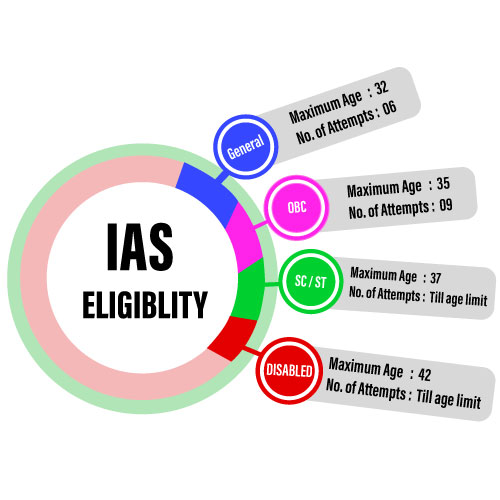
A candidate must have attained the age of 21 years and must not have attained the age of 32 years on 1st August of the year of examination if he is a general category student / aspirant. The upper age limit for IAS as well as all services prescribed above is relaxed for OBC, SC, ST and other categories of aspirants.

iii) Number of Attempts within Age Limit
The UPSC has raised the upper age limit and number of attempts of applicants of the Civil Service Examination with effect from 2015. The upper age limit will be 32 years for the unreserved (general) category with 6 attempts. It will be 35 years for OBC candidates with 9 attempts; and will be 37 years for SC/ST candidates with unlimited number of attempts. For physically handicapped candidates the age limit is 42, 45 and 47 years for General, OBC and SC/ST category respectively while the number of attempts is 9 for General and OBC and unlimited for SC/SC category.

v) Restrictions Relaxed on applying for the IAS exam:
The candidates who are appointed to other services barring the Indian Administrative Service (IAS) and the Indian Foreign Service (IFS) on the results of an earlier examination are eligible to take this examination again.

vi) Other Eligibility Criteria:
Nationality:
The candidate must be a citizen of India to be eligible for the Indian Administrative Service (IAS) and the Indian Police Service (IPS), for other services, a candidate must be either:
a citizen of India,
or a subject of Nepal,
or a subject of Bhutan,
or a Tibetan refugee who came over to India before 1st January, 1962 with the intention of permanently settling in India,
or a person of Indian origin who has migrated from Pakistan, Burma, Sri Lanka, East African countries of Kenya, Uganda, the United Republic of Tanzania, Zambia, Malawi, Zaire, Ethiopia and Vietnam with the intention of permanently settling in India.
Provided that a candidate belonging to categories (c), (d), (e) and (f) shall be a person in whose favour a certificate of eligibility has been issued by the Government of India.
Provided further that candidates belonging to categories (c), (d) (e) and (f) above will not be eligible for appointment to the Indian Foreign Service
Note: A candidate in whose case a certificate of eligibility is necessary is eligible to take the examination but the offer of appointment may be given to only those candidates who have submitted the necessary eligibility certificate issued to him/her by the Government of India.

Note: The Candidates applying for the Civil Service Examination should ensure that they fulfil all eligibility conditions and criteria for admission to examination. Their admission to all the stages of the examination will be purely provisional subject to satisfying the prescribed eligibility conditions. Mere issue of admission certificate to the candidate will not imply that his/her candidature has been finally cleared by the UPSC. UPSC take up verification of eligibility conditions with reference to original documents only after the candidate has qualified for Interview/ Personality Test.

How To Start Preparation ?

Tips to start IAS Preparation at Home
The following tips are given to start IAS preparation:

1: Make a time table

First of all, get the UPSC 2019 schedule (you can download the same from our notifications segment), print it out and stick it on the wall of your room. Mark the dates in red and then chart out a preparation schedule. For this, you have to go through the UPSC syllabus in detail and then prepare a timetable accordingly. You can start with the preparation for both the prelims and the mains together. When you make an IAS time table, you should write down everything. That is, how many hours you should study every day (depending on whether you are working or not), how many hours you should spend on the weekends, after how many days you can take a day’s break, etc. You should also be able to chalk out how much of the syllabus you can cover within a stipulated time. For example, you could say, ‘I will cover ancient history for prelims this week’, and so on. After making a study plan, you should stick to it. Otherwise, there would be no point!

2: Keep a tab on Current Affairs

This is one of the most important segments of the IAS syllabus. In the civil services exam, most questions asked in both the prelims and the mains exams are directly linked to current affairs. Even the questions that are subject-related (such as those from history, geography, economy, etc.) would be linked to any current event/happening that affected the nation or world politically, socially, or in any other manner. Your best bet to be on top of the current affairs segment for the IAS exam is to read the daily newspaper. Experts recommend ‘The Hindu’ as the ideal newspaper for IAS preparation. In case you don’t know how to go about extracting the exam-worthy news from the newspapers, you can watch the BYJU’S video news analysis which we put up on our channel on YouTube every day. These video lectures will give you a detailed analysis of the daily news important for the IAS exam. You will also be given model UPSC prelims and mains questions.

For current Affairs subscribe here for Free……

3: Solve sample UPSC question papers

In the UPSC exam, the competition is intense. You need to perform to your very best if you are to get a good rank in the exam. For this, merely covering the syllabus is not enough. You have to get sufficient exam practice. This holds good for both the prelims and the mains. In the prelims, although the papers are objective in nature (only MCQs), there is negative marking for incorrect answers. This makes the exam tricky. Also, you will need to develop a good speed if you are to finish the papers. The only way to learn how to work around the negative marking to your advantage and to increase your answering speed is by practicing model question papers. Even for the mains exam, where you will be writing descriptive answers, speed is the key. You will have to up your writing speed while being able to give well-explained, crisp and neat answers. Your answers ought to be well-thought out, organised, give what is precisely asked, presented neatly and also substantiated with facts and figures if need be. Achieving all this takes answer writing practice. So, you should enrol for a good prelims and mains test series which would not only give you adequate practice, but also give you the right feedback on your answers so that you can make the necessary course correction.

4: Choose your optional subject wisely

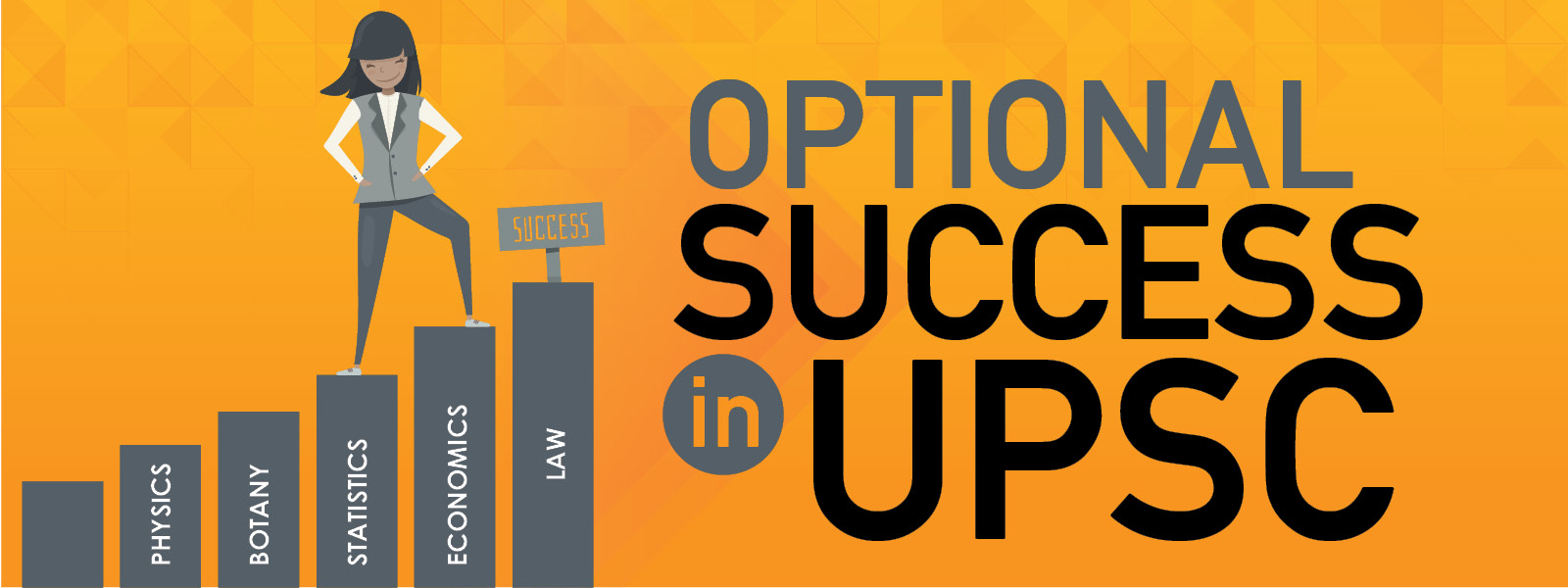
They say we are the choices we make. The same goes true for your optional subject as well! The optional subject accounts for 500 marks in the mains exam and can typically make or break your IAS dream. So, take care to choose a subject that you are comfortable with. In fact, there are certain factors to be taken onto consideration before fixing on an optional. You can learn all about selecting the right optional from the video lecture which we have posted below:

5: Don’t worry, just do what it takes

Preparing for the UPSC exam is not a small task. Sometimes, you can feel bogged down by the enormity of the exam (and the syllabus). But don’t lose hope. It is extremely important for you to be positive throughout the journey. Remember the path could be laden with thorns but the fruit is always sweet. Just stick it out till you make it. It is worth it!

UPSC Syllabus…….

Here, you will find a complete list of subjects for the Civil Services Examination conducted by the Union Public Service Commission (UPSC) The Civil Services Examination is widely considered as one of the toughest and the most prestigious examinations conducted in India. To understand the exam, one needs to understand the syllabus. This helps eliminate wasteful efforts like reading unnecessary topics leading to a loss of time, and keeps one strictly aligned to the expectations of the UPSC from day one.

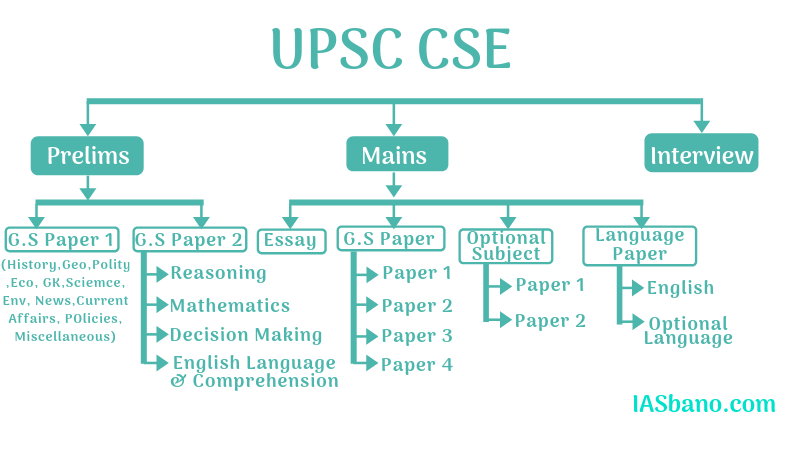
 The UPSC prescribes a common syllabus pattern for services such as the Indian Administrative Service, Indian Foreign Service, Indian Police Service, Indian Revenue Service (Customs and Central Excise) to name a few. The Civil service exam is conducted in three phases:

Phase 1: Civil Services (Preliminary) Examination (Objective Type)

Phase 2: Civil Services (Mains) Examination (Descriptive Type)

Phase 3: Personal Interview (Personality Test)

 PHASE 1: CIVIL SERVICES (PRELIMINARY) EXAMINATION

 The Preliminary Examination is composed of two components:

 1) General Studies

 2) Civil Services Aptitude Test (CSAT) PAPER SUBJECTS TOTAL MARKS DURATION

1 General Studies (GS) 200 2 hours (9:30 AM to 11:30 AM)

 2 CSAT 200 2 hours (2:30 PM to 4:30 PM)

 • Broadly, the Civil Services (Preliminary) Examination consists of two papers of objective type, each of 200 marks (hence totalling 400 marks) and of two hours duration. To qualify for the Civil Services Mains, a candidate must attempt and clear both the papers.

• To clear GS-1 Paper candidate must clear the cut-off mark declared by the UPSC and in CSAT paper, the candidate must score at least 33% of 200 i.e. 66 marks.

• Further, the General Studies (GS) paper consists of 100 questions, while the CSAT paper consists of 80 questions. Both papers have negative marks for wrong answers marked to the tune of 1/3rd of the total marks assigned to that question.

• To further illustrate this, each correctly answered GS question will be awarded 2 marks. So, 0.66 marks would be deducted from the total for every question that is wrongly marked.

• Similarly, in the CSAT paper, since we have 80 questions for 200 marks, correctly answered CSAT question would attract 2.5 marks each, while every wrongly marked question would attract a penalty of 0.833 for each such wrong answer, which will be deducted from the total.

• Questions that are not attempted will not attract any negative marks. The two papers of the IAS prelims are discussed in detail below:

  1. General Studies (GS) The General Studies test is the first paper of the preliminary examination. This test is intended to test the general awareness of a candidate in a wide range of subjects that are included in the syllabus: Syllabus for GS

 • Current events of national and international importance.

• History of India and Indian National Movement.

       • Indian and World Geography – Physical, Social, Economic Geography of India and the World.

• Indian Polity and Governance – Constitution, Political System, Panchayati Raj, Public Policy, Rights Issues, etc. UPSC SYLLABUS 2019

• Economic and Social Development – Sustainable Development, Poverty, Inclusion, Demographics, Social Sector initiatives, etc.

• General issues on Environmental Ecology, Bio-diversity and Climate Change – that do not require subject specialisation

• General Science 2) Civil Services Aptitude Test (CSAT) This test is intended to assess the aptitude of the candidate in solving ‘Reasoning and other aptitude topics that are included in the syllabus: Syllabus for CSAT

• Comprehension

• Interpersonal skills including communication skills

• Logical reasoning and analytical ability

• Decision-making and problem solving

• General mental ability

• Basic numeracy (numbers and their relations, orders of magnitude, etc.) (Class X level), Data interpretation (charts, graphs, tables, data sufficiency etc. – Class X level) PHASE 2: CIVIL SERVICES (MAINS) EXAMINATION

• The Mains examination constitutes the 2nd phase of the Civil Services Examination. Only after successfully qualifying in the prelims exam would the candidates be allowed to write the IAS Mains.

• The Mains exam tests the candidate’s academic talent in depth and his/her ability to present his/her understanding according to the requirements of the question in a time bound manner.

• The UPSC Mains exam consists of 9 papers, in which two are qualifying papers of 300 marks each.

• The two qualifying papers are: 1. Any Indian Language 2. English Language Paper The papers on Essay, General Studies and Optional Subject of only those candidates who attain 25% marks in each of the language papers as a minimum qualifying standard in these qualifying papers, will be taken cognizance for evaluation. In case a candidate does not qualify in these language papers, then the marks obtained by such candidates in other papers will not be considered or counted. Structure of the language papers:

 The types of questions asked are –

1. Essay – 100 marks

2. Reading comprehension – 60 marks

3. Precis Writing – 60 marks

4. Translation: • English to compulsory language (e.g. Hindi) – 20 marks

• Compulsory language to English – 20 marks

5. Grammar and basic language usage – 40 marks

The rest of the seven papers can be written in any of the languages mentioned under the Eighth Schedule of the Constitution of India or in English. Let us look at these papers:

PAPER SUBJECTS TOTAL MARKS

 1 ESSAY (can be written in the medium of the candidate’s choice)250

 2 GENERAL STUDIES – I (Indian Heritage & Culture, History & Geography of the World & Society) 200

3 GENERAL STUDIES – II (Governance, Constitution, Polity, Social Justice & International Relations)

4 GENERAL STUDIES – III (Technology, Economic Development, Biodiversity, Security & Disaster Management)

5 GENERAL STUDIES – IV (Ethics, Integrity & Aptitude)

6 Optional Subject – Paper I LIST OF OPTIONAL SUBJECTS GIVEN BELOW A candidate can also take up literature of language as an optional subject 250

7 Optional Subject – Paper II 250

Please check the detailed UPSC Mains General Studies Syllabus here. Candidates may choose any one of the ‘Optional Subjects’ from the list of subjects given below:

Optional Subjects                                                                      Literature of Language

Agriculture                                                                                               Assamese

 Animal Husbandry & Veterinary Science                                           Bengali

Anthropology

Bodo Botany                                                                                              Dogri

Chemistry                                                                                                 Gujarati

Civil Engineering                                                                                        Hindi

Commerce & Accountancy                                                                     Kannada

Economics                                                                                                 Kashmiri

Electrical Engineering                                                                              Konkani

 Geography                                                                                               Maithili

Geology                                                                                                     Malayalam

History                                                                                                       Manipuri

Law                                                                                                             Marathi

Management                                                                                            Nepali

Mathematics                                                                                            Odia

Mechanical Engineering                                                                         Punjabi

Medical Science                                                                                        Sanskrit

 Philosophy                                                                                                Santhali

 Physics                                                                                                       Sindhi

Political Science & International Relations                                          Tamil

 Psychology                                                                                                Telugu

 Public Administration                                                                             English

Sociology                                                                                                   Urdu

 Statistics Zoology

Please check the detailed UPSC Optional Syllabus here.

 PHASE 3: INTERVIEW/PERSONALITY TEST

 The Interview test will be of 275 marks and the total marks for written examination is 1750. This sums up to a Grand Total of 2025 Marks based on which the final merit list will be prepared. Candidates who qualify the UPSC Mains Exam will be called for the ‘Personality Test/Interview’. These candidates will be interviewed by a Board appointed by the UPSC. The objective of the interview is to assess the personal suitability of the candidate for a career in the civil services by a board of competent and unbiased observers. The interview is more of purposive conversation intended to explore the mental qualities and analytical ability of the candidate

|Top must have Books For UPSC|

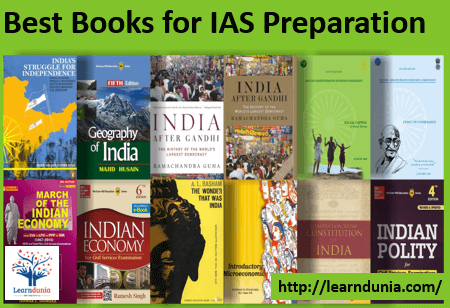
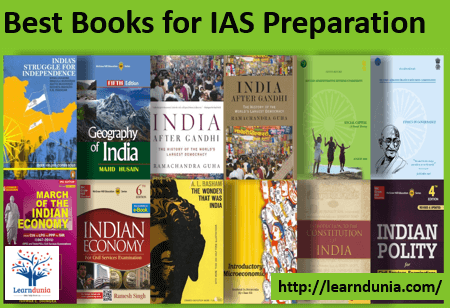
Complete Book List For UPSC IAS Preparation

The UPSC Syllabus for Civil Services Prelims and Mains examination is comprehensive and requires a lot of information sources to adequately address the challenges of the UPSC question paper. Here, we are giving the list of books for IAS Examination.

 NCERT Textbooks

 1. NCERT Text Books from Class 6 – 12th. NCERTs (also OLD NCERTs) are the first step towards IAS preparation. Download them for free here.

2. Or check our free NCERT notes section.

Indian History and Culture

1. India’s Ancient Past – R.S. Sharma.

2. History Of Medieval India – Satish Chandra

3. History Of Modern India – Bipan Chandra.

4. India’s Struggle For Independence – Bipan Chandra. (For Mains only)

5. The Wonder That Was India – A.L. Bhasham (Ancient India and Culture)

6. Indian Art and Culture – Nitin Singhania. (For Prelims – Culture)

7. A Brief History of Modern India – Spectrum (For Prelims)

Indian Geography and World Geography

 1. Oxford School Atlas or any good quality Atlas

2. Geography of India – Majid Husain.

3. World Geography – Majid Husain

4. Certificate Physical and Human Geography – Goh Cheng Leong. (Physical and Human Geography)

Indian Polity and Constitution

 1. Indian Polity for Civil Services Examinations – M. Laxmikanth. (ESSENTIAL FOR UPSC)

2. Introduction to the Constitution of India – D. D. Basu (only for Mains)

Indian Economy

  1. Indian Economy – Ramesh Singh
  2. Often questions on Indian Economy are linked with Current Affairs; more on Current Affairs prep later

Science and Technology

1. Science and Technology in India – Ravi P Agrahari.

 2. Read NCERTs for S&T topics selectively and follow Current Affairs

 Environment – Ecology, Biodiversity and Climate Change

  1. Environment for Civil Services Prelims and Mains – Khuller.

Current Affairs

Visit:- https://crackupsc.school.blog/

 1. India Year Book

 2. Yojana Magazine

 3. Kurukshetra Magazine

4. Economic and Political Weekly

 5. Science Reporter

6. The Hindu/ The Indian Express

7. RSTV

8. Press Information Bureau CSAT

 1. Analytical Reasoning – M. K. Pandey

 2. Verbal & Non-Verbal Reasoning – R. S.Aggarwal For all CSAT related information, preparation strategy and more, check here.

 Other important reference books

1. Essays for Civil Services – Pulkit Khare

2. India After Gandhi – Ramchandra Guha

3. Mastering Modern World History – Norman Lowe

 4. Social Problems In India – Ram Ahuja.

5. Governance in India – Laxmikanth.

 6. India and the World by Surendra Kumar.

 7. Challenges to Internal Security of India – Ashok Kumar.

 8. Lexicon for Ethics, Integrity, and Aptitude – Niraj Kumar.

Importance of Current Affairs in UPSC can’t be stressed enough. Even questions from traditionally static part of the syllabus have become increasingly linked with the current affairs in recent years. At our blog , find the latest UPSC related information curated by experts for your convenience.

1. Gist Of Yojana

2. PIB Summary and Analysis

 3. Daily Comprehensive News Analysis

 4. Daily Analysis – The Hindu

                                                  ALL THE BEST TEAM https://crackupsc.school.blog/

Design a site like this with WordPress.com
Get started